Thinking-Machines and the Atrophy of the Human Part 2
A Wild Call to Become Human Again
In Part 1, we explored how the allure of technological progress has left our deeper humanity hollowed out - rife with unfeeling apathy and with our worldly embeddedness in a state of atrophy. We attempted to explore and briefly articulate how it is that, out from this state of ‘technological wandering’ comes an apathy, a diminishment of a capacity to pay attention and care about what is inherently and truly valuable at the heart of being human.
We are indeed living in the story of Prometheus, our fated mythic ancestor, who in an attempt to excel humanity towards a state of Godliness and technological advancement, sought to place humans above natural lore. Prometheus, a Titan and creator of humankind, steals fire from the Gods, and gives it to humanity. However, Prometheus undertakes this act through deception of Zeus. Whilst the fire which Prometheus steals is a force which fuels the advancement of civilisation, so too this Promethean act is one which symbolises human striving and ambition as an act of rebellion against divine or natural limits. As the myth shows us, we are forever bound to our relationship with forces beyond our control - and in turn, the attempt to rebel against our innate nature, and our relations with the more-than-human world are in fact acts of hubris. This quest for power over the natural world has ironically excavated our own inner nature.
‘Hubris’ from the ancient Greek ὕβρις (hýbris), is associated with ‘violent arrogance’, ‘cruelty’, ‘overstepping proper limits’, and is believed to be ‘an excess that violates cosmic order’. We see the hubris of Prometheus stealing fire from the gods everywhere we look. Ancient birthing trees desecrated, making room for a highway. Expendable lives exchanged for oil. The human imagination mutated into a shopping mall. The irony within this myth of human advancement, is that the very machines of our technological development have now become the masters of our own self-enslavement. Now, Prometheus lives deep in our own unconscious. There are no limits to this hubris.
Yet, we are human, all too human.
Human, from the Latin, Hūmānus, is linked to ‘humus’, meaning: ‘earth, soil or ground’. Etymologically, human literally means ‘of the earth’ or ‘earth bound’. The truth is that we are not gods destined to reign supreme above the Earth, we are humans, inextricably woven into the grounds of Earth itself. To be human is to live with humility. ‘Humility’ from the same root word as human - ‘humilis’ - literally means ‘close to the ground’. Perhaps the greatest act of a human is to live in this direct communion with the grounds of being. To bow in reverence to the Earth, as the Earth bows in return. To be human then, is this very reciprocity of being. The centrality of the human species above all others arises from an impoverished perspective, and only takes us further from the truth of who we really are. If we take humus to heart, we may realise we are closer to compost than machine; more biome than algorithm; living-beings, not zombies.
“If you will contemplate your lack of fantasy, of inspiration and inner aliveness, which you feel as sheer stagnation and a barren wilderness, and impregnate it with the interest born of alarm at your inner death, then something can take shape in you, for your inner emptiness conceals just as great a fullness if only you will allow it to penetrate into you. If you prove receptive to this 'call of the wild', the longing for fulfilment will quicken the sterile wilderness of your soul as rain quickens the dry earth.”
Carl Jung
If hubris and flight from our humanity towards a future-centric, technologically driven world, is the loss of our very essence and natural state as human-animal, this ‘call of the wild’ uttered by Jung may be our path home. ‘Wild’, from old English wilde, etymologically means "in the natural state, uncultivated, not domesticated”. Wild, in this case, meaning, our true nature, is something that is revealed and disclosed to us when we have the courage to see how the very fabric of our Selfhood has been conditioned and constructed from the outside. This is not a call towards pre-reflective animal form, nor is it a negation of technology, culture or civilization. Rather, this call to the wild is about finding our “place in the family of things”, as Mary Oliver invites us. Becoming wild is about widening the circumference of our belonging to the larger body of the world, whilst simultaneously being in communion with our deepest and most unique nature as individual-beings, what Bill Plotkin would call finding our ‘ecological niche’.
Sometimes
I look out
at everything
growing so wild
and faithfully beneath
the sky
and wonder
why we are
the one
terrible
part of creation
privileged
to refuse
our flowering.
David Whyte
So how do we learn how to sense into this larger belonging that is our true inheritance?
If the Thinking-Machine is atrophying our capacity for embeddedness in this world, if technological wandering places us in a trance state of numbness, anesthesia and amnesia, ridding us of our capacities for feeling, if the endless doomscroll degrades our capacities for attention, then we must ask ourselves, what is the antidote to this poison?
Where we arrive at in this question, is a case for the cultivation of the capacities of being that lead us into becoming wholly alive, deeply sensible, and fully-human. We see that the antidote to this Age of Machine is a beckoning to re-animate the human-being. The poison is not in the machine per se. We must see that as imaginative and creative problem solvers, humans inevitably generate tools and technologies. However, when our imaginations are uprooted from the humus - disconnected from the Earth, from our embeddedness, from our bodies and senses - our creations serve to perpetuate this process of uprootedness. The antidote, then, is a question of reconnecting with the wholeness of our human inheritance. We are beings of deep thought woven from sensitive animal bodies gifted with a capacity for imagination. A unique and wondrous aspect of being human is that we have arisen as soil that can reflect upon itself and its position in the world - we have a capacity for self-awareness, contemplation, and deep attentiveness. To live in humility, close to the ground, is to inhabit a role of wisdom upon the Earth, and for our creations to emerge through the spirit of custodianship and care for all the beings we share this ecology with. Modes of thinking and creating from narrow, impatient or unfeeling places lead us further into those places. Modes of being and imagining that are deeply connective and compassionate take us towards a world imbued with such qualities. We must be aware that how we engage with life makes all the difference.
And so, friend, we arrive at the conclusion of this piece with some practices to guide us back into our wild, natural and humble humanity. As we enter the holiday season, our invitation is to make some time for reconnection. These do not need to be extreme experiences, in fact, slow cultivation may be more impactful in the end.
Contemplative Practices for Becoming-Human-Again:
Take Refuge in Aspirational Beings
Reflect on aspirational humans throughout time, that for you, embody the depth, fullness and immensity of a human life. Read about them, watch a documentary about their life, listen to them speak. Write down the values and principles that you perceive they live/lived by. Are there practices or ways of being that embody these values, which you may resonate with and wish to bring into your life? Print out photos of these aspirational beings. Hang them on your wall. Look at them, reflect on their lives, talk to them, let them talk to you. Learn to bow at the feet of beings that have lived immense lives - let their lives, their teachings, their guidance become a source of refuge and inspiration.Learn a Poem or a Myth off by Heart.
Let it sink into your bones. Recite it often. Meditate on it. Share it with a friend. Speak it to a place in nature that you love. Journey with it and see how it shapes your consciousness.‘Living the Questions’ as a Spiritual Discipline
Beloved teacher Krista Tippett invites us to live the questions as a spiritual discipline. She asks us to “formulate a question that is rolling around in your life or in that boundary between what is personal and what is public or civilizational. Write it down, hone it, and make a commitment to it. Commit to having it over your shoulder, in your ear, as you move through your life. See what it invites you to see and to move towards and to move away from…Start by writing this down and giving it a month, or giving it a year…”Learn to see your Emotions as Gods (The Art of Emotional-Alchemy)
Meditate on the poem ‘The Guest House’ by Rumi: https://www.scottishpoetrylibrary.org.uk/poem/guest-house/
When an emotion arises at your door, engage it, welcome it, learn from it. Let each emotion speak through you, be a student of the wisdom of your feeling body. Use sentence stems to let your feelings speak through free associative writing (a practice modified from the work of Francis Weller). Put on a timer for five minutes and don’t stop writing - everytime you get stuck or go into your head, repeat the sentence stem and keep writing. Some sentence stem examples are:
‘My real grief…’
‘My tears…’
‘I long…’
‘I lost…’
‘My heart…’
‘I set down…’Make your Own ‘Bible’
Ralph Waldo Emerson tells us to,“Make your own Bible. Select and collect all the words and sentences that in all your readings have been to you like the blast of a trumpet”. The invitation here is to start your own book of inspiration from everything that stirs your heart awake. Quotes, poems, your own beautiful thoughts, images, symbols. Create a compendium which aids you in coming deeper into your self, a place of refuge for you to seek solace, a place to constellate that which is most beautiful, meaningful and evocative for your unique Soul.Let the Forest Find You:
Meditate on the poem ‘Lost’ by David Wagoner; https://onbeing.org/poetry/lost/.
You may do this by going out into a wild place, and speaking the poem to the wind and to the trees and all that is present, within you and within the space around you; you may choose to do this multiple times. Carry in your heart a question of where and how you may be ‘lost’ in some way, with the intention to let something be revealed to you, something which is hidden at the edge of your awareness. With each reading of the poem, stand still and listen for the subtle whispers. As Wagoner notes, “the forest knows where you are - you must let it find you”.Gather in ‘Deep Listening’ in Community, with Friends and the More-than-Human World:
Venture out, to a local parkland or unbounded natural place, with one or two friends (or more). Find a place to gather, and head out individually on a walk, in silence, for 15-20 minutes. Pay close attention to what it is you are called to, and what it is that calls out to you. Look and listen and hear the symbols of the world which speak to you, those which help guide and inform you about what is alive and turning in your psyche. Are you drawn to things that are sprouting, dying, shedding, flying, crawling, singing, decaying? Pay attention to where your psyche is drawn. Use the natural world as a mirror into your own unconscious. Return to your meeting spot with your friends, and gather in counsel to reflect. Allot 3-5 minutes for each individual to share what it is they saw, and were seen by.Cleave to Beauty as Survival:
Beloved poet Mary Oliver speaks about the necessity of“keeping the appointment” as a practice of consistent, mindful attention with wonder. Whatever it is that brings you into a wakeful state of attentiveness to the beauty of the world, cleave to these practices as an act of utmost survival. Whether that be writing, reading poetry, connecting to bird song, tending to your garden, deep dialogue with a friend, singing for the sake of singing. Practice the art of ordinary astoundment. Make friends with the beauty that is often invisible, unnoticed, hidden under your very nose. Gaston Bachelard reminds us that the world longs to be adored. Seriously, go smell the roses.Practice the Art of Friendship:
Beloved poet, the late Andrea Gibson, writes:
“In any moment,
on any given day,
I can measure
my wellness
by this question:
Is my attention on loving,
or is my attention on
who isn't loving me?”
Practice the art of generosity of spirit. Tend to your friendships and the wellbeing of others without need for return. Love for the sake of love. Care for others as practice. Do you have a friend going through a difficult time? Bring them soup, serve them tea, rub their feet. This type of being weaves the web of relationality that we all need so deeply.A Food Blessing:
Before a meal with loved ones, take some time before eating together to imagine the journey that each part of your meal took to get to your plates. Where did your salt come from? What about vegetables or meat? Remember the sunshine and water that has been captured and transformed within each piece of food. Whose hands were involved? Imagine the cars, trucks, ships and planes that participated in this meal. Offer gratitude to this web of relations. And perhaps even offer a compassionate bow to the aspects of this meal that may have caused suffering.
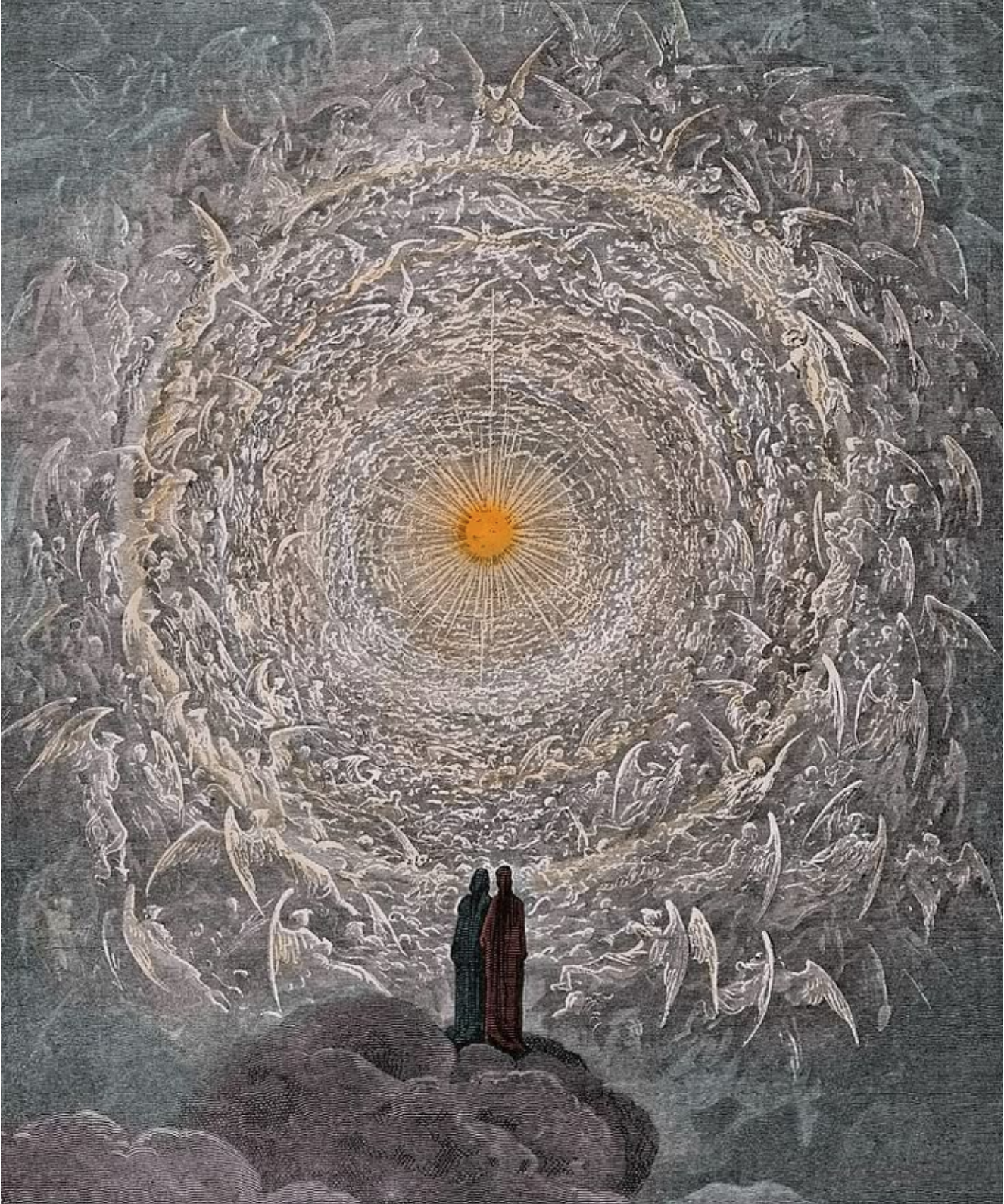
Gustave Doré - The Empyrean
“In times of crisis for humanity, amid the genocides and the wars and the burning forests and the firing squads of self-righteousness, the only true remedy is to remember what it means to be human — the complexity of it, the contradictions, the panoply of capacities from which get to choose in becoming who we are, as persons and as peoples.”
Maria Popova