Thinking-Machines and the Atrophy of the Human Part 1
Atrophy and Apathy
In the age of the worlds night, the abyss of the world must be experienced and endured. But for this it is necessary that there be those who reach into the abyss”
Martin Heidegger
The Thinking-Machine has seamlessly taken a position in our collective minds as a trusted ‘other’ - something to turn towards for knowing. More disturbing than merely seeking abstract knowledge is that in our dark moments, where so many are isolated and displaced, the Thinking-Machine has now become the one to turn-towards to be-known.
The desire for this ‘trusted other’ is evident in the pervasive turning towards AI for companionship, community, therapy - in some way, ChatGPT and its robotic AI accomplices have become the church, the community, and the ‘healer’, as we attempt to fill these voids which have been brought forth by technology itself.
Not only have we killed God, we have replaced them with a ChatBot.
The Thinking-Machine has filled the void where there was once a rich presence of living-relationships - and in an even deeper sense, it has begun to occupy the landscape of our inner world. This excavation of our inner-world is slowly eroding the very fabric of what it means to be human, from the inside-out.
In his seminal works on ‘Building Dwelling Thinking’, and “The Question Concerning Technology”, Martin Heidegger illuminates the dichotomy and split we find ourselves in. Heidegger speaks to the division between ‘Dwelling’ upon the Earth, and what he refers to as ‘Technological Wandering’. For Heidegger dwelling means “to cherish and protect, to preserve and care for”. Since dwelling is the manner in which mortals exist and “belong together”, the inability to dwell renders one homeless and alone on the earth - which in turn, leads us to seek some sense of ‘togetherness’ in relation to technology. Thus, we find ourselves in the space of ‘Technological Wandering’ - in this state, the world appears only as a resource. This technological mode causes a kind of wandering: a rootlessness, whereby we become disconnected from place and tradition - a restlessness, which encourages constant productivity, acceleration and novelty seeking, instead of reflection. It leads us towards a homogeneity, and a forgetting of being, who we are, individually and collectively, human and more-than-human. Instead of dwelling with the earth, humans try to master it technologically, becoming alienated from their own deepest nature.
Amidst a barren landscape, devoid of a ‘Dwelling’ upon and with the Earth, we find ourselves ravaged and starved, turning towards a ChatBot or a social media feed for a kind of relational ‘pseudo-nourishment’. It is indeed these forms of technology which have atrophied our capacity to be fully human, which have led to a wasting away of our faculties of attention and presence. Etymologically, atrophy refers to a ‘lack of nourishment’. The impact of this can be seen in reports of what is now being referred to as ‘brain-rot’ (i.e. the atrophy of one’s capacity to think for, or know themselves, and the sullying of the mind and its faculties to know another and the world). Paradoxically, the malnourishment found in our inability to ‘dwell’, and therefore, our inability to form relational-embeddedness, leads us to reach for contact with the very non-entity that ultimately starves us of true connection.
Amidst this absence of ‘true-connection’ found through a reciprocal participation with an animate, alive, breathing world, we are left deprived and ‘apathetic’, unable to be touched and moved by life itself.
Apathy, from Greek apatheia, means “without feeling” or “without suffering”. Joanna Macy argues that apathy is critically dysfunctional in the collapse of life-support systems as it blocks our relationships to the living-world. The psychological repression and numbing resultant through apathy cripples’ individuals into a passivity and dissociative state of being, devoid of ‘compassion’ - leaving us wholly incapable of ‘suffering-with’ and responding to the call of our time.
If this is the case, that technology and our modern moment has robbed us of what it means to be human, what shall we say then is the medicine which is found within the poison? What alchemical transmutation must we undergo to transform this powerful Pharmakon we hold in the palm of our hands?
In part 2, we will examine what is missing and the invitation to become wild and human, again.
“In an age that distrusts passion, when the heart's affections are watered down by distraction and petty fear, remember your incalculable birth. You are as much a miracle as a pearl of sand or a star. Do not, as the majority does, pretend that indifference is sovereignty. Passivity is a fashionable distraction from the work of beauty, power or pain. But no one ever belonged powerfully to life through insensitivity. Passivity breeds illness of body, heart, and mind. Passivity unbelongs us from the heart of being. Therefore, when difficulties come your way, face them directly, as in a mirror bravely. Hardship endured without denial always becomes some form of trust in yourself. You become a more resonant sound, as if, by the hearth, on a long winter's night, you are your own quiet guest, parallel to the meditative fire. Passivity has no calm; it arrives at no hearth. Neither is passivity neutral. It is a nerveless scar, but without the alchemy of injury. Passive, the vital spirits that wanted you to transform rove away; they visit less and less.”
Zhenevere Sophia Dao
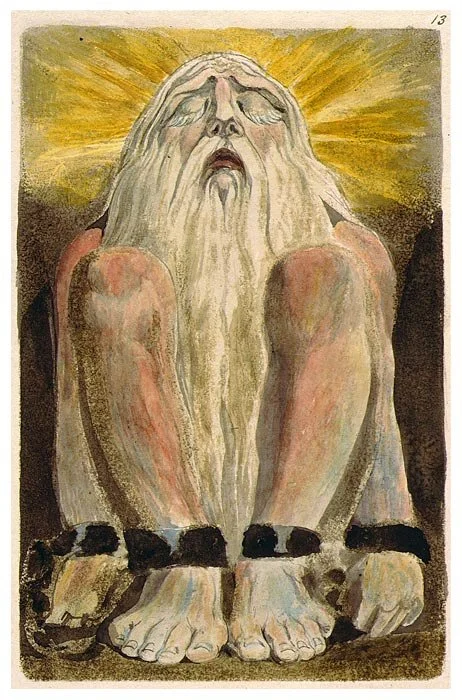
Urizen, from ‘the first book of Urizen’ - William Blake